
49 Days With You
‧₊˚❀༉‧₊˚.


An uneasy experience where players sit back to back to create a story on the effects of grief and the unresolved internal and external conflicts from loss.
Navigate the difficult conversations that come with losing someone, learn to move forward, confront fears or attachments, and peacefully let each other go — or fail to do so.
Prompt-Based TTRPG
2 Players
1.5-Month Solo Class Project
Playtime: ~60 min. (Short Ver.) | ~90+ min. (Regular Ver.)
Current Status: Complete / Released on itch.io

Gameplay Overview
Trending: Buddhism is an experimental board game meant to critique one way modern America has appropriated and aestheticized Asian culture. It transforms karma into a tangible currency, significant Buddhist symbols and artifacts into decoration; and encourage players to buy Buddhist items or accumulate karma to win.
Core Features & Basic Gameplay Loop
Mechanics
Dynamics
Aesthetics
Ideation
In Buddhist, Taoist, and Shinto traditions, rituals are performed for 49 days after death to help guide the departed through the bardo, the state between death and rebirth, toward a favorable reincarnation.
49 Days With You is a 49-day, prompt-based, physical back-to-back duet exploring the memories, perspectives, and connections between a grieving individual and the recently deceased—one moving through life while the other stays stuck in time.
Thematic Significance
This game grew out of my interest in the fragility and ephemerality of life and memory, even beyond death. It's an experimental experience for players to explore these themes while still having fun telling their own stories.
Prompt
Designing the prompts meant considering how they should be framed and what questions would drive conversation or storytelling. It worked best to create everyday situations that players respond to with a set "toolkit," allowing for varied, unique storytelling instead of one fixed plot. I wanted players to go beyond the modern world and beyond just loved-one relationships. Hence, the prompts and set up supports player creativity so that the deceased could be a spirit in a medieval fantasy world, a murder victim, or even a pet.
Inspired by Thousand Year Vampire, prompts describe something that's already happened, and players build off it. I find games more fun when they hand you an encounter and let you handle the details and consequences through your own choices. It makes players feel like the character even without control over the broader world. The prompts do what a GM would: create encounters and situations.
Physicality
I incorporated a leaning mechanic inspired by The Time We Have, a game about two siblings and their last conversations before one is fully turned by a zombie virus. Sitting on opposite sides of a closed door, unable to see each other, they rely only on voice. At the end, the uninfected sibling decides whether to open the door. That physical barrier heightens imagination since when one sense is blocked, the brain fills the gap with whatever is imaginable or plausible.
I used this same principle with touch. Players sit back-to-back, unable to see each other, relying only on voice and the warmth and pressure of the other's body. Removing sight and replacing it with touch forces players to imagine what they can't perceive. As they lean into each other and the weight shifts,
players become emotionally and physically
codependent.
Design
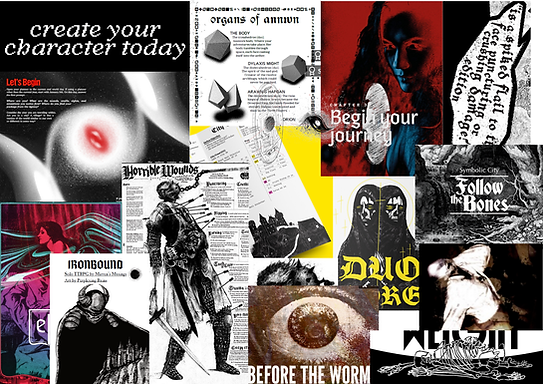
Colors: Black, White, & Yellow
White and yellow are common in Buddhist funerals:
yellow for humility and enlightenment,
white for purity, serenity, and mourning.
Font: Amanojaku and EB Garamond
A brush-stroke calligraphy font evokes Buddhist
scripture for titles and statement phrases;
EB Garamond is the closest match I found to
the translated scriptures I grew up reading at the
temple.
Playtests + Iterations
Playtests were completed with friends, family, and classmates. Some were partners, siblings, or acquaintances. There were a total of three iterations spanning one month and two weeks of development.
Through Iteration 01 and 02, I learned that:
-
Players tend to forget mechanics and rules mid-play.
-
Roles were not clarified sufficiently.
-
Play styles varied drastically and they should be embraced.
-
The weigh mechanic was easily forgettable.
-
The back-to-back physicality caused fatigue and pain, despite prior precautions.
-
Day and night transitions felt abrupt, disturbing the flow of the story.
-
Grammar and punctuation were lacking, causing further confusion.
-
Play would go on too long on regular mode.
With Iteration 03, I implemented:
-
Small, cuttable reference cards that players can look at throughout play to remember the core actions, rules, and roles.
-
Embraced any play style!
-
Made the weight mechanic an intentional closing reflection by moving it to the end of each day instead of each turn.
-
Restructured an action loop that requires both players to establish part of the event/situation and to properly close the day.
-
Cleaned up grammar and punctuation for clarity.
-
Added more physical alternatives to reduce strain from prolonged back-to-back sitting.
-
Added the Ace of Hearts as the base win condition.
-
Changed the card to time scale. Each card represented three days (regular play) or a week (short play) instead of one for faster and more detailed gameplay.